If you’ve ever typed a quick question into ChatGPT or Claude and gotten a mediocre, generic answer, the problem usually isn’t the AI — it’s the prompt. AI models respond to what you actually give them, not what you meant to say. The good news: writing better prompts isn’t a mysterious skill. It’s a handful of habits you can learn in one sitting.
Here’s a simple framework to build any prompt around.
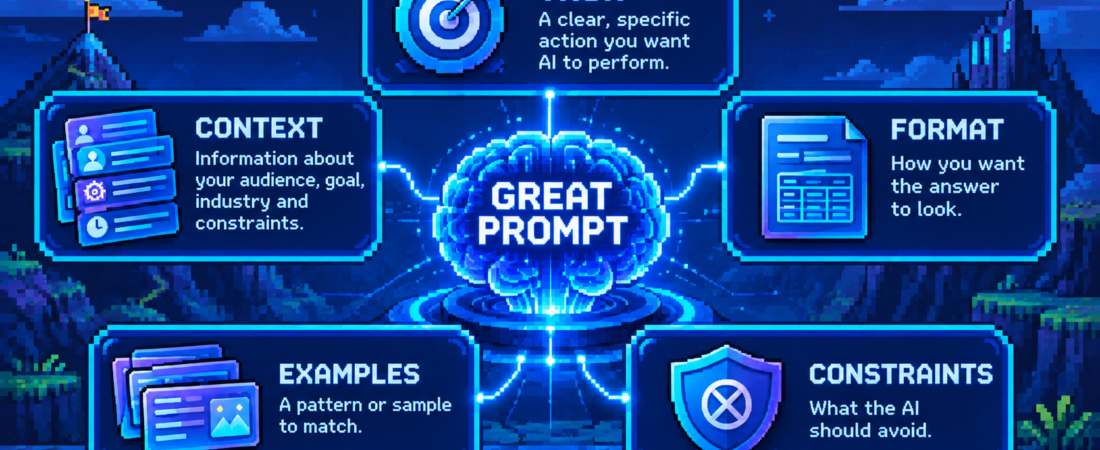
The Five Building Blocks
1. Task — What do you actually want?
Start with a clear, specific action. Not “help with my resume,” but “rewrite the bullet points in my resume’s experience section to sound more results-driven.”
Vague prompts get vague answers. The more precisely you name the task, the less guessing the AI has to do.
2. Context — What does the AI need to know?
This is the piece people skip most often. The model doesn’t know your industry, your audience, your constraints, or your goal unless you tell it.
Compare:
- ❌ “Write a product description.”
- ✅ “Write a product description for a $40 ceramic coffee mug, for an Etsy shop that targets gift-buyers, in a warm and slightly playful tone.”
The second version gives the model something to work with — and you’ll notice the difference in the output immediately.
3. Format — How should the answer look?
If you want a table, a numbered list, a short paragraph, or code with comments, say so. AI models default to whatever format feels statistically “average” for the request, which is often not what you actually need.
Try adding lines like:
- “Respond in a table with three columns.”
- “Keep it under 150 words.”
- “Use bullet points, no intro paragraph.”
4. Examples — Show, don’t just tell
If you have a specific style in mind, one example is worth several sentences of description. This is especially powerful for tone, writing style, or structured outputs.
“Write a product tagline in this style: ‘Coffee that gets you. Literally.’ Now write one for a reusable water bottle.”
Giving the model a pattern to match dramatically improves consistency.
5. Constraints — What should it avoid?
Tell the model what not to do, just as clearly as what to do:
- “Don’t use corporate jargon.”
- “Avoid exclamation points.”
- “Keep technical terms to a minimum — this is for beginners.”
Constraints prevent the AI from defaulting to generic patterns that don’t fit your situation.
Putting It Together
Here’s a full example combining all five elements:
Task: Write three subject lines for a re-engagement email. Context:The email is going to customers who haven’t opened our newsletter in 60+ days. We’re a small independent bookstore. Format: Give me three options as a numbered list, each under 8 words. Example:Something in the tone of “We miss you (and so do the books).”Constraints: No emojis, no “we noticed you’ve been away” clichés.
Notice how specific this is compared to just typing “write me some email subject lines.” The output will be night-and-day different — and far closer to something you can actually use.
A Quick Mental Shortcut
If you’re in a hurry and don’t want to think through all five blocks every time, just ask yourself one question before you hit send:
“If I handed this prompt to a smart freelancer who’s never met me, would they know exactly what to produce?”
If the answer is no, you’re probably missing context, format, or constraints — and that’s exactly what’s costing you a good response.
Why This Matters More As AI Gets More Capable
As models like GPT-6 Astra and Claude Fable 5.1 get better at complex, multi-step tasks, the gap between a lazy prompt and a well-built one only grows. A vague prompt to a powerful model doesn’t just get a mediocre answer — it can send the model down an entirely wrong path for ten steps before you notice. Precision at the start saves time at the end.
Try It Yourself
Next time you write a prompt, pause before sending and check: task, context, format, examples, constraints. You won’t need all five every time — but knowing they exist means you’ll reach for the right one when a response falls flat.
Want a library of ready-made prompt templates for specific tasks like emails, resumes, or content ideas? Let us know what you’d find useful.