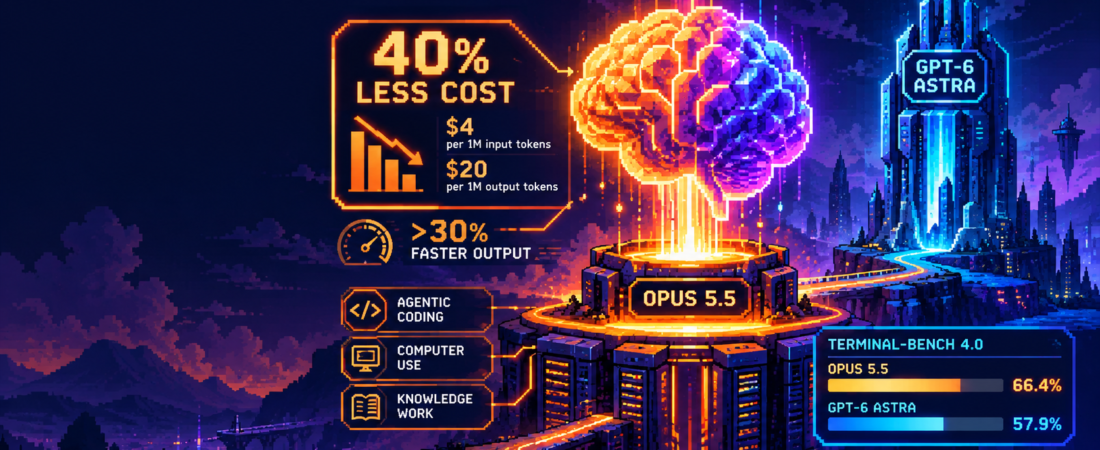
Anthropic has released Claude Opus 5.5, the first model in its new Claude 5.5 family — and it’s already generating waves of hype across social media and tech blogs. Before you believe every headline calling it “the new king of AI,” let’s look at what Anthropic actually announced, what the benchmarks really show, and where the hype train has run ahead of the facts.
What Actually Launched
Opus 5.5 is the successor to Opus 5, which was released just two months earlier on July 24, 2026. According to Anthropic, the new model performs at roughly the level of the company’s top-tier Fable 5.1 model on most tasks — while costing significantly less to run and generating output more than 30% faster than its predecessor.
That’s a meaningful jump: Opus has historically been Anthropic’s most expensive, most capable tier, sitting above Sonnet and Haiku in the lineup. Getting Fable-level performance out of the mid-tier flagship, at a fraction of the cost, is the real headline here — not that it “destroys” anything.
Sonnet 5.5 and Haiku 5.5 are expected to follow “in the coming weeks,” bringing similar performance and pricing improvements to the rest of the lineup.
The Pricing Breakdown
Here are the actual numbers, since pricing claims tend to get garbled the most in translation:
| Opus 5.5 | Opus 5 | |
|---|---|---|
| Input tokens (per 1M) | $4 | $5 |
| Output tokens (per 1M) | $20 | $25 |
| Cache reads (per 1M) | $0.20 | $0.50 |
| Cache writes (per 1M) | $5 | $6.25 |
On paper, that’s a straightforward 20% price cut. But Anthropic says the real-world savings are closer to 40%, because Opus 5.5 uses fewer tokens to complete the same task and runs noticeably faster — meaning you pay less per token andneed fewer tokens to get the job done.
How It Stacks Up Against GPT-6 Astra
This is where a lot of the “new king of AI” framing comes from, and it’s partly justified. Anthropic’s own published benchmarks show Opus 5.5 ahead of OpenAI’s GPT-6 Astra on most categories tested:
- Terminal-Bench 4.0 (agentic coding tasks): Opus 5.5 scored 66.4% vs. Astra’s 57.9%
- FrontierCode v1.1: 54.4% vs. 53.3%
- GDPval-AA v2.1 (Elo rating): 1846 vs. 1542
- Humanity’s Last Exam (with tools): 67.7% vs. 57.2%
- Opus 5.5 also came out ahead on OSWorld 2.0, a computer-use benchmark
But it’s not a clean sweep. Astra actually beat Opus 5.5 on two of the categories Anthropic tested:
- AutomationBench, a Zapier-run business workflow benchmark
- Terminal-Bench-Science, a test of agentic scientific research, where Astra scored 64.6% against Opus 5.5’s 58.7%
So the honest summary is: Opus 5.5 leads on most coding and general-capability benchmarks, but it isn’t universally superior. Anyone claiming “no equal in programming” is rounding up.
Safety, Alignment, and a Deliberate Slowdown
One detail that got buried under the pricing and benchmark headlines: this release comes just after Anthropic CEO Dario Amodei publicly called for the industry to slow the pace of frontier AI development — deliberately pacing capability gains to match progress on alignment. Opus 5.5 is the first model released since that call.
Anthropic says the model was tested before launch by external evaluators, including METR and Frontier Design, and scored the best of any Claude model to date on the company’s internal automated behavioral audit — its most comprehensive alignment test suite. Because its biology and cybersecurity capabilities are considered comparable to Anthropic’s most advanced models, Opus 5.5 ships with the same safeguards used for high-risk domains, limiting things like exploit discovery in compiled software or biological weapons–relevant tasks.
Availability
Opus 5.5 is available now across Anthropic’s own platform as well as Amazon Web Services, Google Cloud, and Microsoft Azure. Developers can access it via the API using the model ID claude-opus-5-5.
Separating Signal from Hype
If you’ve seen the version of this story circulating in Russian-language tech channels, it probably read something like: “Opus 5.5 destroys Fable 5.1 and GPT-6, no equal in coding, might shake up game development.” Here’s what’s true and what’s embellishment:
True:
- Opus 5.5 launched with a real, verified 20% list-price cut (closer to 40% in practical savings)
- It matches — not exceeds — Fable 5.1 performance on most tasks
- It beats GPT-6 Astra on most, but not all, published benchmarks
Hype:
- “Destroys” Fable 5.1 — it performs at the level of Fable 5.1, not beyond it
- “Pocket AGI” — a catchy phrase, not a claim Anthropic makes
- Threatens to “shake up game development” because GPT-6 could make browser games — this appears nowhere in Anthropic’s materials or independent benchmark coverage
The lesson here isn’t really about Opus 5.5 specifically — it’s a good reminder for anyone following AI news: check the primary source (in this case, Anthropic’s own announcement) before repeating a headline. The real story is usually interesting enough on its own; it just doesn’t need the extra coat of hype paint.