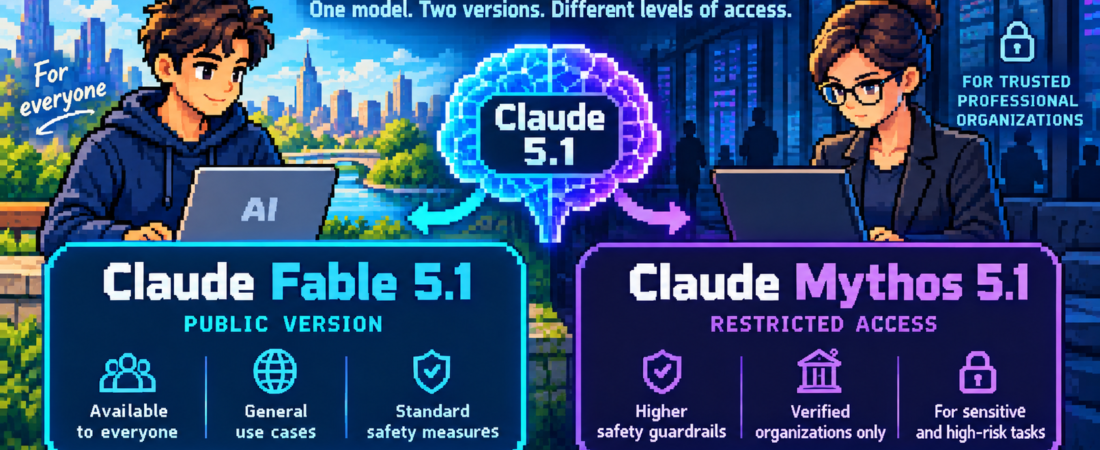
On September 1, 2026, Anthropic released two new AI models at once — Claude Fable 5.1 and Claude Mythos 5.1. If the naming feels confusing (why two models, and why “Mythos”?), here’s what’s actually going on, and which one you’ll ever use.
Same Model, Two Different Guardrails
The key thing to understand: Fable 5.1 and Mythos 5.1 aren’t two different AIs. They’re the same underlying model, released with two different sets of safety restrictions. Anthropic has said as much directly, describing the pair as identical in capability but different in the level of safeguards applied.
Think of it like the same car sold in two trims: one with the safety features tuned for the general public, and one — available only to vetted specialists — with certain limiters removed for professional work that genuinely needs them.
- Claude Fable 5.1 is generally available to everyone, across the Claude API, AWS, Google Cloud, Microsoft Azure, and the regular Pro, Max, Team, and Enterprise plans.
- Claude Mythos 5.1 is restricted to vetted organizations through trusted-access programs, with its extra capabilities aimed specifically at cybersecurity defense and life-sciences research.
If you’re a regular user, Claude, ChatGPT-style — you’re using Fable. Mythos exists for a narrow, credentialed audience.
Why the Split Exists
Fable 5.1’s safety system is built to hand off certain sensitive requests — things touching cybersecurity or advanced biology — to a less capable fallback model instead of answering directly. That’s a deliberate trade-off: keep the flagship model broadly useful and safe for millions of people, while still allowing legitimate professional users (security researchers, biologists) to access the model’s full capability through separate, monitored channels.
Mythos 5.1’s access has reportedly grown to cover two verification tracks: one for cybersecurity defenders, and a newer Life Sciences Verification Program developed with the US government for scientific researchers. For now, that access is limited mostly to US-based organizations, with plans to expand.
What Actually Improved
Beyond the safety architecture, the headline upgrades in Fable 5.1 are practical ones:
- Fewer false alarms. Anthropic says the updated safeguards cut unnecessary flags on harmless requests significantly — useful if you’ve ever had a coding or research question get needlessly blocked.
- Lower cost. Cache-read pricing dropped substantially, which translates to real savings for heavy or agentic workloads — up to roughly 45% cheaper for the most demanding use cases, according to Anthropic.
- Stronger performance. Anthropic reports Fable 5.1 outperforming its predecessor and rival models on several coding, knowledge-work, and scientific-research benchmarks.
- EU AI Act watermarking. In line with European transparency rules Anthropic signed onto this year, Fable 5.1’s text output now carries an invisible watermark, with a detection tool available to eligible regulators and researchers.
The Bigger Picture
The Fable/Mythos split isn’t just a naming quirk — it reflects a broader pattern among AI labs: as models get more capable, companies are increasingly shipping a “safe by default” public version alongside a more permissive, tightly controlled version for professional or governmental use cases. Expect to see more of this structure as frontier models keep advancing on dual-use domains like biology and cybersecurity.
Bottom Line
Unless you’re a vetted cybersecurity or life-sciences professional, Mythos 5.1 isn’t something you’ll ever interact with directly — and that’s by design. What matters for most people is Fable 5.1: a faster, cheaper, less trigger-happy version of Anthropic’s top model, now available across all the usual platforms.
Curious how Fable 5.1 stacks up against GPT-6 Astra or Gemini? Let us know — a head-to-head comparison could be next.